

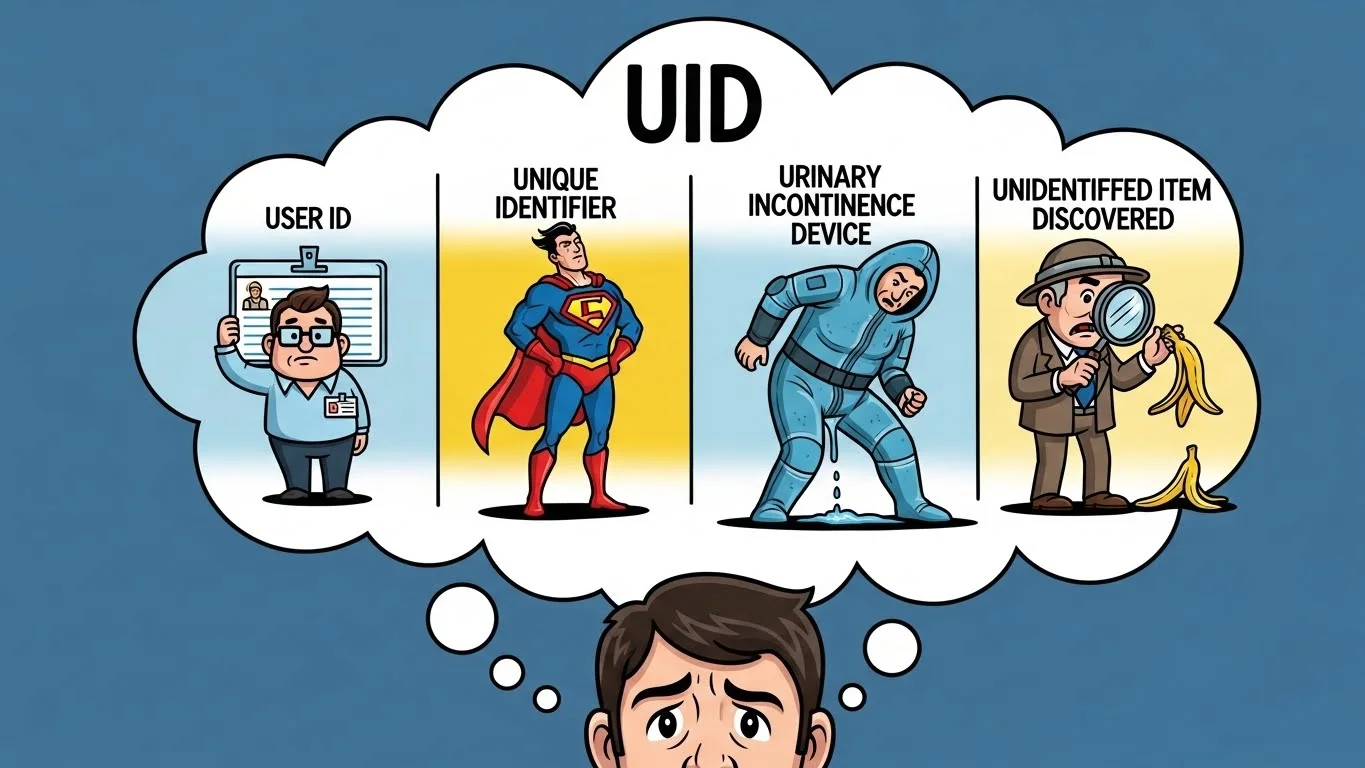
What Does “UID” Mean?
UID stands for “Unique Identifier.”
Key points:
It’s a code or number that uniquely identifies a person, object, or account
Ensures that each entity is distinct and not confused with others
Commonly used in technology, databases, apps, and government systems
In simple words: A UID is a special ID that belongs to only one person, device, or record.
Different Uses of UID
1. Technology & Software
UID identifies users, devices, or sessions.
Example: Each Facebook account has a unique UID in the database.
Purpose: Helps track activity, login, or permissions.
2. Government & Official IDs
UID is used in government programs like India’s Aadhaar UID.
Example: “The UID is linked to your biometric and personal details.”
Purpose: Ensures unique identification for services, benefits, or taxation.
3. Apps & Online Platforms
Apps assign UIDs to users for tracking, analytics, and personalization.
Example: “Your app UID helps us remember your preferences.”
4. Databases & Records
UID is essential in databases to prevent duplication.
Example: Customer databases assign a UID to each client for easy retrieval.
UID vs ID
ID (Identifier) – General term for identification
UID (Unique Identifier) – Specifically guaranteed to be unique
Example:
ID: “Student ID = 12345” (could exist elsewhere)
UID: “UID = 9876543210” (unique in the system, no duplicates)

Real-Life Examples of UID
Example 1 (Tech):
Your Gmail account has a UID in Google’s backend to track your account.
Meaning: This number is unique to you in the system.
Example 2 (Government):
India’s Aadhaar UID links your biometric data with your personal records.
Meaning: The UID ensures no two citizens share the same ID.
Example 3 (Apps):
“Each device gets a UID when registering on this platform.”
Meaning: The system can recognize each device separately.
Common Misunderstandings
UID is only for people
False. It can identify devices, accounts, sessions, or records.
UID and username are the same
False. Usernames can be changed; UIDs are permanent and unique.
All IDs are UIDs
False. Not all IDs are guaranteed to be unique globally.
UID is visible to everyone
False. Some UIDs are internal to systems and not public.
Related Terms
UUID (Universally Unique Identifier) – A globally unique identifier used in programming
User ID – Identifier for a user in a system
Serial number – Unique number assigned to devices or products
Biometric ID – UID linked to fingerprint, face, or iris data
These terms often appear alongside UID in tech and official contexts.

Why Understanding UID Matters
Ensures digital security and accuracy
Helps in government services, banking, and tech platforms
Prevents duplicate records or identity confusion
Essential for programmers, tech users, and students
What Does “UID Meaning” Really Come Down To?
When people search “UID meaning”, they want a simple answer:
UID means Unique Identifier—a special code, number, or ID that is unique to a person, device, or record to ensure it can be distinguished from everything else.