
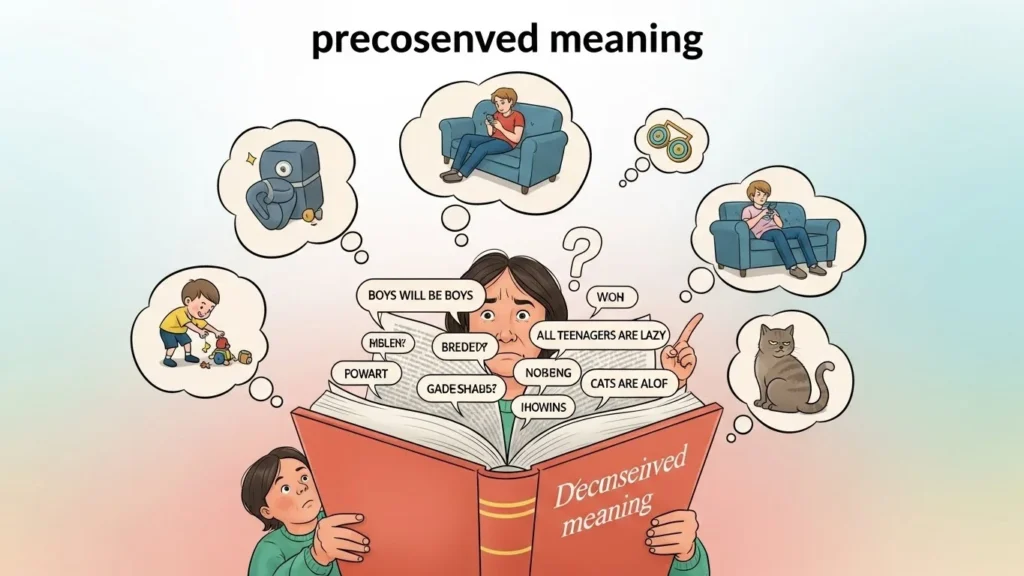
What Does “Preconceived” Mean in Chat or Text?
The term preconceived is primarily an adjective. Its literal meaning is:
“Formed before having full knowledge or experience of something; based on assumptions or biases.”
Key Meanings:
Based on Assumptions or Biases
A preconceived opinion or idea is one you have before fully understanding the facts.
Example: “She had a preconceived idea about the new student, but he turned out to be really friendly.”
Prejudgment
Often refers to forming opinions without enough evidence.
Example: “He approached the discussion with a preconceived mindset, which made it hard to listen.”
Usage in Chat/Internet Conversations
In texting or social media, “preconceived” can be used humorously or seriously when someone jumps to conclusions.
Example: “I had a preconceived fear that the movie would be boring, but it was amazing.”
Origin & History
The word preconceived comes from Latin praeconceptus, meaning “taken in advance” or “formed beforehand.” Its use in English dates back centuries, but it has become common in modern online discussions where people critique assumptions, share opinions, or reflect on biases.
How People Use “Preconceived” in Real Conversations
Understanding context is key when using preconceived online or in chat:
Platforms:
Texting: Used in personal conversations to explain assumptions or clarify misunderstandings
Social Media: Twitter threads, Instagram captions, and TikTok videos often reference preconceived ideas
Discord & Forums: Used in debates or discussions to highlight bias or judgment
Professional Contexts: Occasionally appears in emails, reports, or presentations to discuss assumptions
When to Use:
To point out assumptions or biases in conversation
To explain a misjudgment or expectation
To sound thoughtful or precise in discussion
When to Avoid:
Overusing in casual memes or jokes—it can sound too formal
Using in contexts where simpler words like “assumption” or “bias” are more natural
Real-Life Examples of “Preconceived” in Text Messages
Here are some examples of preconceived in modern chat:
Personal Chat Example
Friend 1: “Did you like the new restaurant?”
Friend 2: “I had a preconceived thought it would be too expensive, but the food was amazing.”
Explanation: Shows the speaker’s initial assumption before gaining experience.
Social Media Comment
“I had a preconceived idea that online classes were boring, but this one was really engaging!”
Explanation: Humorously highlights how expectations can be wrong.
Group Chat Discussion
“Don’t go into the debate with a preconceived mindset, listen to their points first.”
Explanation: Advises avoiding bias or premature judgment.
Gaming Context
“I had a preconceived notion that this boss fight would be easy… big mistake.”
Explanation: Casual, playful use to express initial assumptions.
Professional Email Example
“Our preconceived expectations about the market trend were adjusted after reviewing the data.”
Explanation: Demonstrates formal usage, showing adaptation after gaining new information.
Common Mistakes & Misunderstandings
Even experienced speakers can misinterpret preconceived:
Confusing it with “preconceived concept” or “idea”:
“Preconceived” alone works as an adjective, not a noun.Correct: “Preconceived notions can be misleading.”
Wrong: “I had a preconceived yesterday.”
Using it in overly casual chat:
While it works in thoughtful discussions, using it too often in memes or casual DMs can feel stiff.Tone Misinterpretation:
Some may interpret it as formal criticism rather than casual observation—context matters.Mixing with slang incorrectly:
Avoid combining it unnecessarily with text slang like “bruh” or “lol,” unless intentionally humorous.
Related Words & Abbreviations
Here are some words closely related to preconceived:
Assumption – A simpler synonym for preconceived thought
Bias – Often linked to preconceived opinions
Judgment – Refers to forming opinions too early
Prejudgment – A direct synonym emphasizing unfairness
Using these related words in conversations or online posts can make your writing or chatting more precise and natural.