
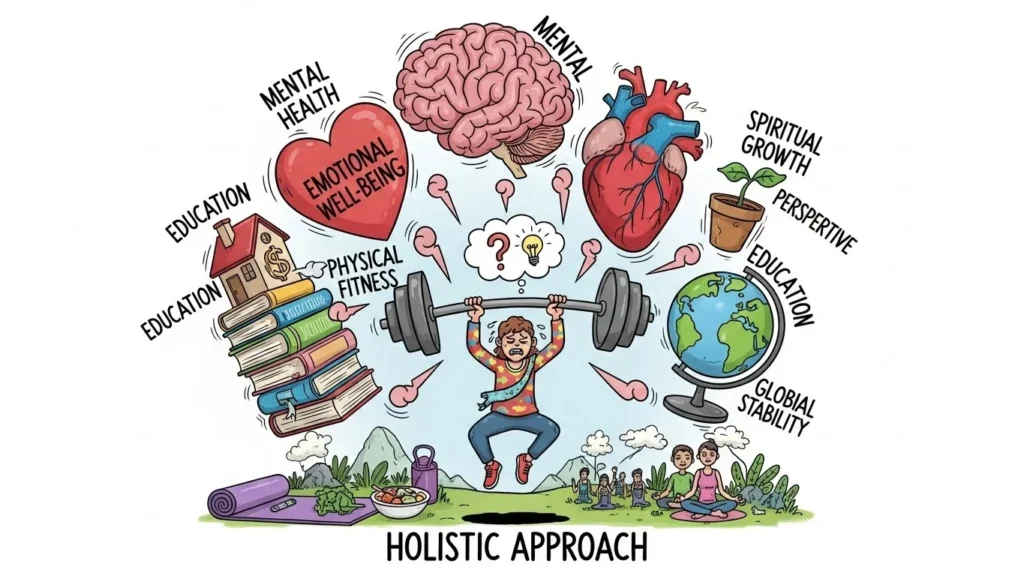

What Does “Holistic Approach” Mean?
A holistic approach is a way of looking at a situation, problem, or person as a whole rather than as separate parts.
Key points:
Focuses on overall well-being, balance, and interconnectedness
Looks at physical, mental, emotional, and social factors together
Opposite of a narrow or reductionist approach
In simple words: it’s about considering everything that affects a situation, not just one aspect.
Origin of the Term
Comes from the word “holistic”, which is derived from the Greek word “holos”, meaning whole or entire.
Originally used in medicine and philosophy to emphasize treating the whole person, not just symptoms.
Today, it’s applied in healthcare, education, business, and personal development.
Holistic Approach in Different Fields
1. Healthcare & Medicine
Focuses on body, mind, and spirit.
Example: Instead of only prescribing medicine, a holistic doctor may suggest nutrition, exercise, stress management, and therapy.
Key benefit: treats root causes, not just symptoms.
2. Education
Educates the whole child, not just academics.
Example: Encouraging emotional intelligence, creativity, and social skills alongside math and science.
Key benefit: Develops well-rounded students.
3. Business & Management
Considers all aspects of a company: employees, customers, finances, and sustainability.
Example: A holistic business strategy includes customer experience, employee engagement, and environmental impact.
Key benefit: Better long-term decision-making.
4. Personal Development
Focuses on improving mental, physical, emotional, and spiritual well-being.
Example: Practicing meditation, regular exercise, healthy diet, and meaningful relationships.
Key benefit: Balanced and fulfilled life.

How to Apply a Holistic Approach
Look at the big picture – Don’t focus only on symptoms or immediate problems.
Consider interconnected factors – Think about how one area affects another.
Combine multiple strategies – Use complementary solutions for a better outcome.
Focus on prevention, not just cure – Anticipate issues before they become bigger.
Review and adjust continuously – Holistic approaches are dynamic and adaptable.
Examples of a Holistic Approach
Example 1 (Healthcare):
A patient with high blood pressure receives medication, nutritional counseling, stress management tips, and exercise plans.
Meaning: Treating the whole person, not just the symptom.
Example 2 (Education):
A school provides academic lessons, mindfulness exercises, art classes, and teamwork activities.
Meaning: Teaching the whole child, not just academics.
Example 3 (Business):
A company focuses on customer satisfaction, employee training, eco-friendly packaging, and community programs.
Meaning: Considering all areas of the business.
Common Misunderstandings
Holistic approach = alternative medicine only
False. It applies in healthcare, education, business, and daily life, not just alternative therapies.
Holistic approach ignores details
False. It considers details but within the context of the whole system.
Holistic approach is slow or unnecessary
False. It may take time but prevents problems and improves outcomes long-term.
Holistic approach is vague
False. It’s structured and strategic, focusing on interconnected factors.
Benefits of a Holistic Approach
Improves overall well-being and health
Enhances long-term effectiveness in business or education
Encourages balance and prevention
Supports personal growth and self-awareness
Strengthens relationships and social cohesion
Related Terms
Whole-person care – Healthcare term similar to holistic approach
Integrated approach – Combining multiple methods or disciplines
Systems thinking – Understanding complex interconnections
Mind-body-spirit approach – Focus on physical, mental, and spiritual wellness

What Does “Holistic Approach Meaning” Really Come Down To?
When people search “holistic approach meaning”, they want a clear explanation:
A holistic approach is a way of considering the whole system or person, including all interconnected factors, rather than focusing on a single part.