

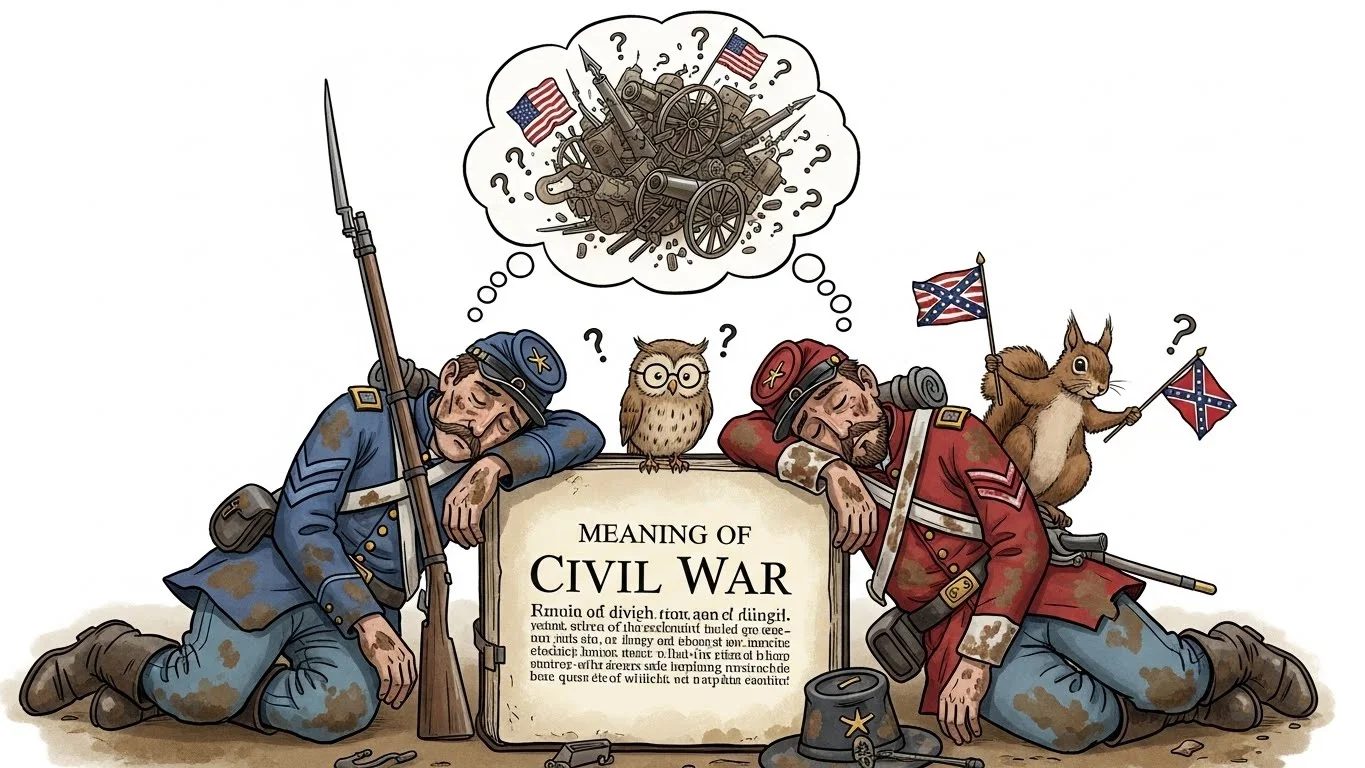
What Does “Civil War” Mean?
At its core, a civil war is a war fought between groups within the same country or nation, rather than between different nations.
Clear Definition
Civil War (noun):
An armed conflict within a single country between organized groups, often over political, social, economic, or ethnic issues.
Can involve government forces versus rebels, or rival factions seeking control.
Meaning Based on Context
Historical Context: Wars such as the American Civil War (1861–1865) or the English Civil War (1642–1651).
Modern Usage: Internal conflicts in countries like Syria, Yemen, or Libya.
Figurative Usage: Sometimes used metaphorically to describe intense internal disagreements in organizations, communities, or even families.
Origin and History of the Term Civil War
The term “civil war” comes from the Latin word “civilis,” meaning citizen or relating to citizens.
Historically, civil wars have occurred since ancient times, often when factions within a state or empire compete for control.
Famous examples:
American Civil War (1861–1865): Fought over slavery and states’ rights.
English Civil War (1642–1651): Conflict between monarchy and parliament.
Spanish Civil War (1936–1939): Between Republicans and Nationalists.
Civil wars often reshape nations, lead to social upheaval, and impact future governance.
How People Use “Civil War” in Real Life
Historical Example
Teacher: “The Civil War ended slavery in the United States.”
Explanation: Refers to the American Civil War and its historical consequences.
News & Media Example
Reporter: “The country is on the brink of civil war due to political instability.”
Explanation: Refers to potential internal armed conflict within a nation.
Figurative Example
Colleague: “Our department is having a civil war over the new policy.”
Explanation: Metaphorical use to describe internal conflict or disagreement.

Real-Life Examples of Civil War Usage
Example 1: American History
“The Civil War lasted from 1861 to 1865 and resulted in significant social and political change.”
Explanation: Refers to a literal civil war with national consequences.
Example 2: Modern Conflict
“International organizations are monitoring the civil war in Syria closely.”
Explanation: Refers to an ongoing internal conflict within a country.
Example 3: Figurative Use in Business
“The two teams are in a civil war over which project to prioritize.”
Explanation: Metaphorical usage describing internal conflict without violence.
Example 4: Literature or Media
“The novel portrays a country torn apart by civil war.”
Explanation: Shows usage in storytelling and fiction.
Example 5: Education or Discussions
“Understanding civil wars is crucial for studying modern history and geopolitics.”
Explanation: Highlights educational and analytical use of the term.
Common Mistakes & Misunderstandings
Mistake 1: Confusing Civil War with Regular War
Civil war is internal, while wars like World War II are between different countries.
Mistake 2: Using Civil War for Minor Conflicts
The term implies organized, large-scale conflict, not small arguments or skirmishes.
Mistake 3: Ignoring Causes
Civil wars often arise from political, social, ethnic, or economic tensions—not just personal disputes.
Mistake 4: Thinking All Civil Wars Are Short
Civil wars can last years or even decades, often with devastating consequences.
Related Terms & Concepts
Rebellion / Insurrection: Smaller-scale uprisings within a country.
Faction: A group or subgroup involved in a civil conflict.
Revolution: Sometimes overlaps with civil war but usually aims to overthrow government structures.
Guerrilla Warfare: Common tactic in civil wars involving irregular combat.
Internal Conflict: Broad term encompassing civil wars and smaller domestic disputes.