
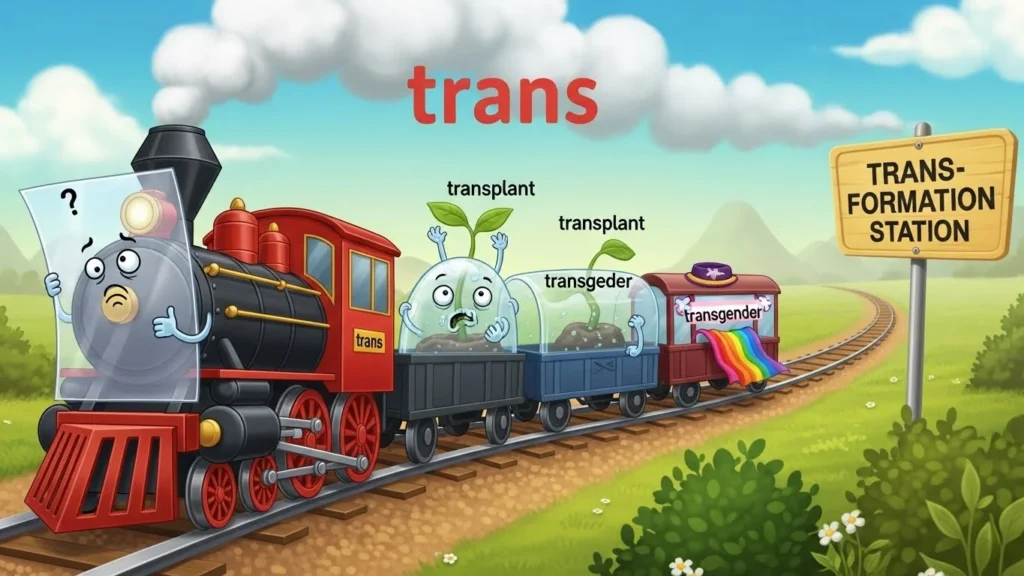
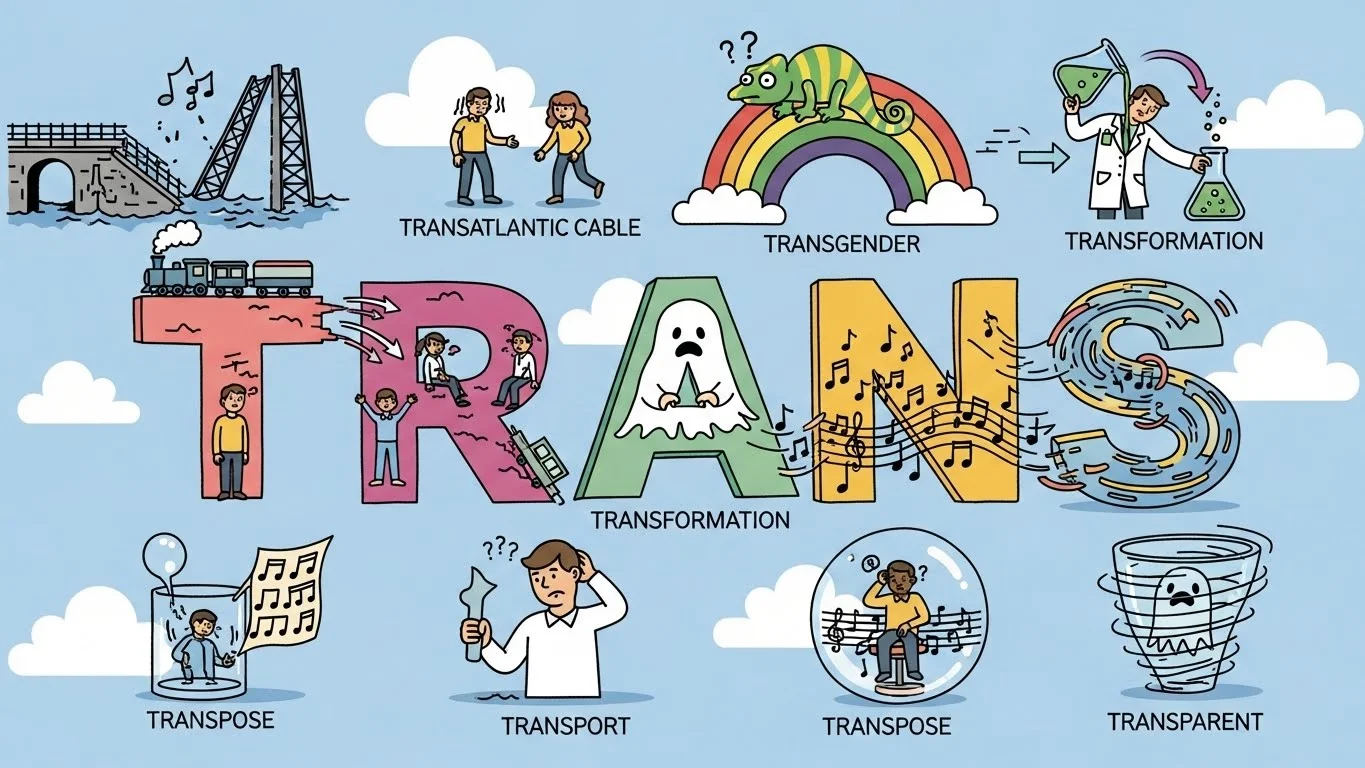
What Does the “Trans-” Prefix Mean?
The prefix “trans-” comes from Latin “trans”, meaning “across,” “beyond,” or “through.”
Simple definition:
Trans- = across, beyond, or through
When added to the beginning of a word, trans- modifies the word to indicate movement, change, or crossing from one state or place to another.
Core Uses of the Trans- Prefix
Movement Across or Beyond Something
Example: Transcontinental – across continents
Example: Transport – carry across from one place to another
Change or Transformation
Example: Transform – change in form, appearance, or nature
Example: Transfigure – change into something more beautiful or elevated
Crossing Social, Gender, or Identity Boundaries
Example: Transgender – someone whose gender identity differs from the sex assigned at birth
Example: Transition – the process of changing or moving from one state to another
Scientific or Technical Usage
Example: Transatlantic – across the Atlantic
Example: Transdermal – through the skin
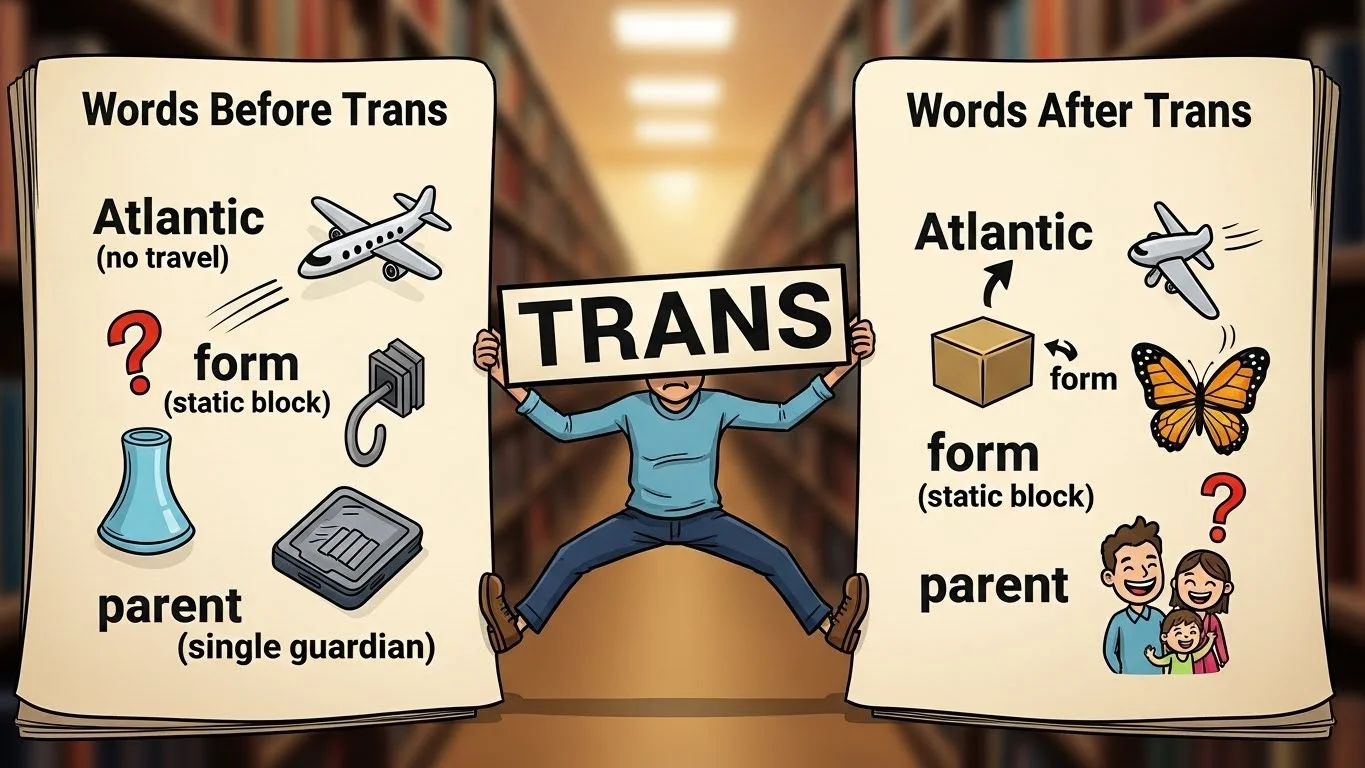
How “Trans-” Changes Word Meaning
Adding trans- usually indicates movement, crossing, or change:
| Base Word | With Trans- | Meaning |
|---|---|---|
| Port | Transport | Carry across |
| Form | Transform | Change form |
| Atlantic | Transatlantic | Across the Atlantic |
| Continental | Transcontinental | Across continents |
| Derma (skin) | Transdermal | Through the skin |
Understanding the prefix helps you decode unfamiliar words and infer meaning.
Real-Life Examples of “Trans-” Prefix Words
Transport – Moving goods or people across a distance
“They used trucks to transport the goods.”Transcribe – Write across or copy words
“She transcribed the meeting notes.”Transcend – Go beyond limits
“His courage transcends fear.”Transcontinental – Crossing a continent
“The train route is transcontinental.”Transgender – Crossing traditional gender identity boundaries
“He identifies as transgender.”Transatlantic – Across the Atlantic Ocean
“They took a transatlantic flight to Europe.”
Common Mistakes & Misunderstandings
Confusing trans- with tri- or tra-
Tri- = three, tra- is not a standalone prefix.Assuming trans- always relates to gender
While common in modern discussions, trans- has broader linguistic and scientific uses.Mispronouncing it
Correct pronunciation: /tranz/Using trans- incorrectly in casual conversation
Example: Saying “trans-movie” instead of “across-the-movie” doesn’t make sense.
Related Prefixes
Understanding trans- can be easier when compared with similar prefixes:
Ex- = out of, from
Example: exit, exhalePer- = through, completely
Example: perceive, perforateInter- = between, among
Example: international, interactMeta- = beyond, about
Example: metaphysics, metadata
These prefixes also indicate movement, change, or crossing in different ways.
Trans- Prefix in Modern Language (2026)
Technology: Transcoding, transceivers, transmedia storytelling
Social discussions: Transgender, transition, trans rights
Science & health: Transdermal patches, transgenic organisms
Travel & geography: Transatlantic flights, transcontinental routes
In 2026, understanding trans- helps with reading comprehension, academic studies, and even keeping up with online discussions.